Friday, February 21, 2014

PIECES COMING TOGETHER

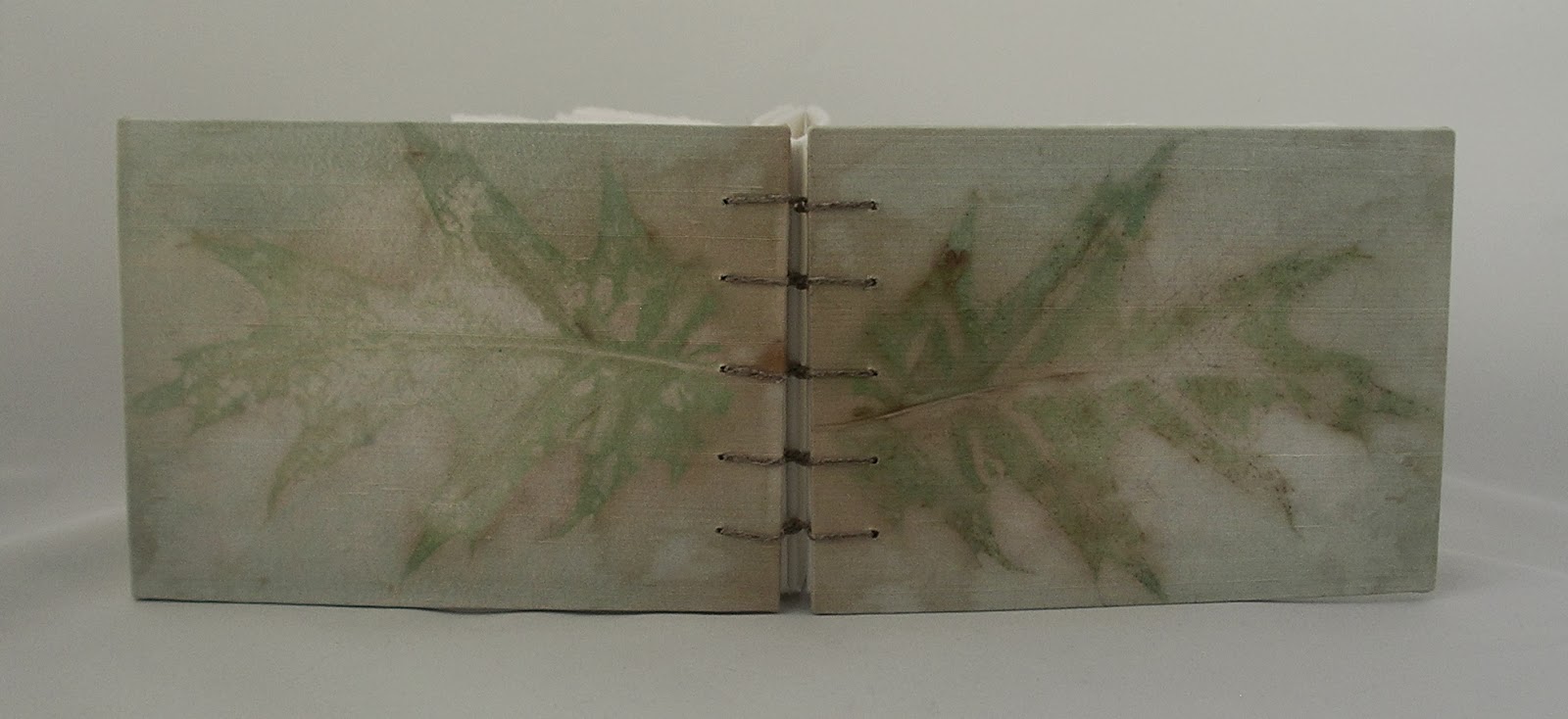
Vintage linen dyed in indigo during an online class taken 4 years ago.
 Scrap paper stained with rusty objects.
 Eco printed silk left out in the cold for months.
Sometimes disparate pieces come together to form a whole. Really needed this life lesson right now .

Thursday, February 13, 2014

GOOD BYE ETSY

With all the changes that Etsy has made in the last year, I have decided to close my shop  and join Big Cartel. Etsy isn't about handmade anymore. It's just about money. Making lots of money was never my goal for having an online store. It was just to have an online presence for people to view what I do and purchase if they wanted to.  So this is very much an ethical decision rather than a financial one.  Big Cartel offers one set fee and none of the hassle of constantly renewing product as well as keeping up on whatever Etsy might decide to change tomorrow. So my new shop address is http://peggydlugos.bigcartel.com . I'll be adding product over the next several days.

Thursday, February 6, 2014

WHEN LESS IS MORE

Last Fall I soaked a few cherry branches and stems in some of Manitou Spring's iron rich water*. I soaked some vintage cotton along with the branches and left them to soak for 48 hours. Then I  wrapped the branches in the fabric and steamed them and let them to cure for a week. Upon unwrapping I immediately saw this landscape. This is all nature's doing (except for the sketch of the tree on the left.) Click on the image for a larger view.
 
 My original plan was to "bring out" the landscape with stitch. Define the areas with thread marks to "improve" the scene. After two days of stitching, ripping, stitching, ripping, getting angry, stitching and ripping some more, I remembered my motto for 2013's year of eco-dyeing: Accept the gift which nature has to offer." Don't try to force things; don't ask mother nature to produce something similar to a rubber stamp image. Just look for the magic in what I have, not in what I wish I had. I was so pleased with the scene my eye was seeing in the lines created by the contact of the branches with the fabric and the shapes made by the bleed of the pigments. But then I lost myself in trying to make things too realistic and not trusting that a viewer's brain could also fill in the blanks and imagine the trees, bushes, water, etc. So after more ripping this is what I have now.


There is still more ripping to do. In the foreground you'll notice a line of white stitching, It's covering up the resist mark made by a stem which gives a nice line in the landscape. The stitching, to me, just makes it too obvious and like I am trying to control the scene too much. Ripple marks in the water on the right, they are going too. The only stitch I really like is the tree. I think it provides a nice focal point and adds to the mood of the scene.
 
So I would love to hear your thoughts. Do you go by the less is more, or more is more line of thought. I think I use both approaches but I am getting better at discerning when it is best to use one over the other.
 
*Iron Spring water contains 13.30ppm (equals milligrams per liter) of iron. When you initially  collect the water, it looks clear, but after settling for a few hours you can see red stuff floating around in it. GROSSSSSSSSSSSS. Which is why I dye with it and don't drink it.

Wednesday, January 29, 2014

DAYS FOR MAKING "SCRAP" BOOKS

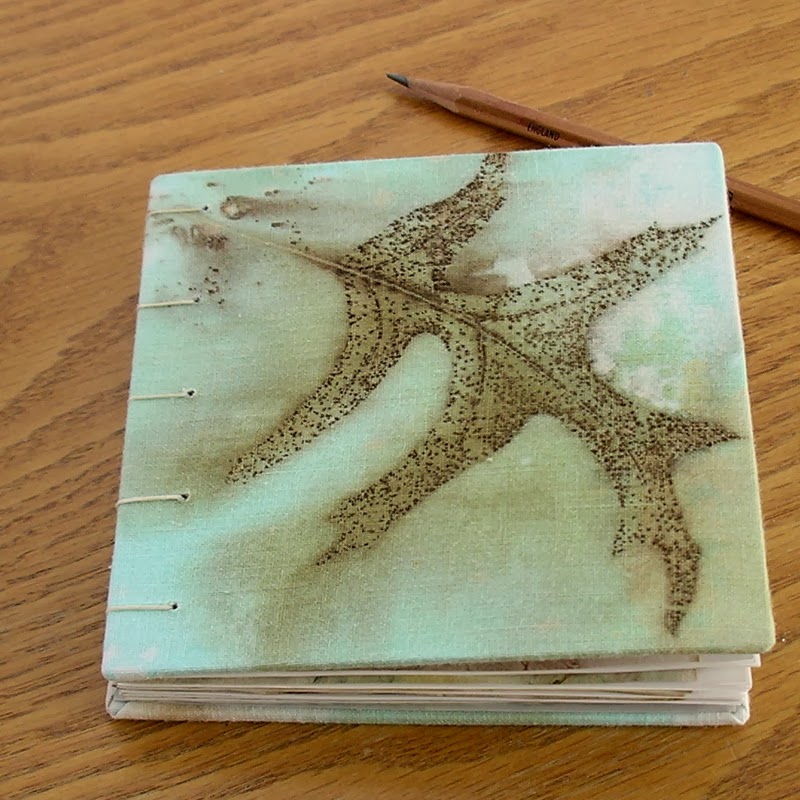
I love scraps. The smallest piece can make my heart sing. I love to go through my piles, looking at what is left over from other projects. What I have come to learn is that working with the scraps is what makes me happiest. Making a whole out of disparate parts. So the last two snow days allowed me time to do so. Indigos and rust prints made on cast off linens and cottons come together with old paper and cardstock; cuts from watercolor papers used to make contact prints become book covers; small pieces of paper from larger book making adventures become the perfect size for the pages of souvenir books of summertime leaf printing. Small pieces of vintage threads become the ties that bind it all together.

And after being inside for way too long, I went out and shoveled snow to melt for my next dye experiments with red cabbage.

Sunday, January 19, 2014

CARROT TOP EXPERIMENTS

I spent the week working with carrot tops saved from our summer garden. We keep our carrots in  the ground until we need them or the ground freezes. With the mild autumn we had, we still had some in the ground until the first week of December. Not bad for Colorado! Each time we brought some in from the garden I stored the tops in the freezer. Since doing this I learned that it would be better to store them dry. Will have to try that next year.
 
So with the amount of tops I ended up with I was able to test three different mineral springs against tap water.  "The spring water of Manitou Springs originates from 2 sources. Deep-seated waters of the Rampart Range and Ute Pass provide one source of mineral water. Water below surface is run through cavernous drainage systems call Karst aquifiers. Limestone in the water dissolves and resulting carbonic acid, or carbon dioxide makes the water effervescent. The waters rises to the surface naturally. This process is an  artesian process where as water rises through layers of rock it picks up minerals and soda or sodium bicarbonate. Some of the spring water also  comes from surface water from the watershed basins of Fountain Creek and Williams Canyon. Each spring has a different mineral content and because of that, a different taste."* And for my purposes a difference in dye color achieved. (Side note: You may remember hearing about flooding in Colorado this past summer. A lot of it was in the Fountain Creek and Williams Canyon area mentioned above. All of this flooding was due to the Waldo Canyon fire in 2012 which left the hillsides bare and ripe for flash floods. Because the mineral springs are below ground they were not contaminated by the ash that came down in the flood.)

Top left scraps photo are silk dyed in Wheeler spring water which has the highest amount of copper. Middle two fabrics (silk left, vintage cotton right) were dyed in Seven Minute Spring water which has an even distribution of all minerals. Love the color of the vintage cotton(premordant with alum). Right three scraps are two different types of silk and a vintage cotton dyed in tap water. The middle  piece of silk was wrapped around a copper pipe. Not very visible in the photo but there is a difference in color between it and the left silk without the copper pipe.

Next row is silk and vintage cotton dyed in Iron spring water named because of its high content of iron. Again not very visible in the photo, but a more muted, grayed green.

So I'm out of carrot tops for now.  There are still two more springs I want to test with carrot tops but that will have to wait till next summer's crop.

This week I'll be in the library researching Dr. William Bell, founder of Manitou Spring. I know that he and his wife had a garden, and I would like to find out what they planted and if any were dye plants.

*Manitou Springs Mineral Foundation

Sunday, January 12, 2014

RECORD KEEPING

 In 2008 I learned to make a flag book. It was fun to learn to make this structure but I came away  from the workshop thinking I would probably never make this type of book again. It sat on a corner shelf in my basement until this past summer when I was trying to come up with a way to keep track of my eco prints on paper. I wanted a way to display  my prints by season so that I would be able to see differences in pigments using the same plants but at different times of the year.
 
 So I used the same flag book structure to make this book with prints made during June, July and August. A variety of leaves were used including Silver Maple, Aspen, Cottonwood, Juniper, Geranium, Gambel Oak, Crabapple, Chokecherry and Serviceberry as well as petals from Coreopsis, Marigold and Iris plants. The cover was made using only iris and marigold petals.

 Last week I finished another flag book recording prints made during September, October and November. Leaves from the same plants were used but were showing their autumn pigments. I also included berries from plants available during those three months (Chokecherry and Woodbine).

 Cover fabric is vintage cotton mordanted with alum and printed with Woodbine berries, Gambel Oak, Norway Maple and Rose leaves and a few Coropsis petals.

 I am very happy with this method of recording my prints and am presently working on my book for December, January and February.

Monday, January 6, 2014

POETRY TO BEGIN WITH

WHAT WE NEED IS HERE

Geese appear high over us,

pass, and the sky closes. Abandon,

as in love or sleep, holds

them to their way, clear

in the ancient faith; what we need

is here. And we pray,

not for new earth or heaven, but to be

quiet in heart, and in eye,

clear. What we need is here.

               --Wendell Berry